



Thanks to the international farmers’ meeting organised by the Rwandan Initiatives of Change team, in November 2011, I was able to make a third trip to Rwanda and meet with people who are warm-hearted, generous, hard-working and forward-thinking despite the ever-present traces of the past.
The conversations that I had during visits to farms or agricultural projects, during the farmers’ meeting held at the foot of the volcanoes in the north of the country or on private occasions, all confirmed the thoughts, questions and challenges that I had started to see during my second trip in March (see 'The suffering of the Rwandan soul').
The visit of a huge project to renovate a marshy valley into an irrigated farming production area, on land that will be redistributed to small scale farmers, clearly demonstrated a very strong political desire to ensure that food production is increased, to cover the needs of an already very large population (more than 400 inhabitants per Km² - the average farm has less than half a hectare) and to end malnutrition and poverty. Our guide, a soldier, showed us also a large farm that has been recovered from a military zone and integrated into the consolidation programme. This programme aims to group together by zone the production of different crops in order to render the entire production and marketing chain more efficient. Although we may wonder, and rightly so, to what extent a centralised organisation can encourage the participation and responsibility of farmers, we should also recognise that Rwanda has given itself the means to develop in the face of huge challenges.
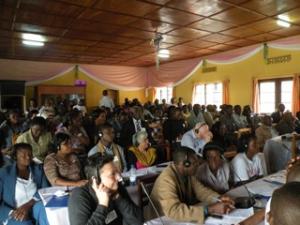
The Rwandan Initiatives of Change team is currently preparing a report, for the meeting in Ruhungeri, which brought together 130 farmers (half of whom came from Rwanda and the other half from 16 other countries, notably in East Africa).
Here, nevertheless are a few snippets from exchanges that took place over the four days:
- Mr Jim Wigan (International coordinator for Farmers’ Dialogue) and Mr Jamil Ssebalu (coordinator for Africa) highlighted the importance of individual commitment. This can occur through meetings and a change in motivations. For Jim this means 'serving others instead of your ambition, feeding the world instead of getting rich'. It can also occur through working together to resolve the problems that farmers face. The meeting’s theme reminds us all of this challenge: “Farmers – men and women – working together for food security, building trust and unity…”
- A Rwandan official spoke about how lucky he was to be in his current situation (a job, a home, a car, a family…) but whilst listening to his Somali colleague he was reminded of the 25 years he spent as a refugee being fed by the International Red Cross. “It’s time I gave back what I received”, he added emotionally.
- Farmers’ Dialogue has greatly developed over the last few years in East Africa thanks to the commitment on the ground. The project’s approach has proved its worth thanks to the concrete results it has produced not only in practical terms on the farms but also in terms of the behaviour of its members. Farmers’ Dialogue is, therefore, becoming an important partner for rural and agricultural development. The Ugandan delegation is an example of this: amongst the 13 participants, standing alongside the farmers was a Regional District Commissioner, a representative from the Kingdom of Boganda (one of the country’s regions) and a farming journalist.
- A training course was organised in March in Rwanda for the leaders of Farmers’ Dialogue in the different countries where the project is active. One of the participants shared his experiences as a result of this: he decided to put an end to the things he was hiding from his wife, he asked for forgiveness, which in turn renewed his family’s unity and improved their ability to work together for the development of their small farm and the farms around them.
- 'Be the change you want to see in the world!' The meeting in Rwanda showed how true this message also is in responding to the challenges of food production, the fight against hunger and poverty. It also shows that each individual has a role to pl ay regardless of the amount of responsibility they hold.
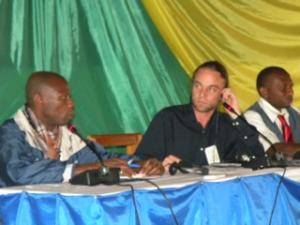
The more formal meetings at the Ministry of Agriculture, the French Embassy and the farming trade union Imbaraga and the more private conversations with the Initiatives of Change team confirmed to me the importance of the development currently underway in Rwanda, the courage and the determination of Rwandans to participate in it. Of course it’s not easy! The more you talk to them and the more you discover the complexity of their human relationships and individual paths, the more you understand that the trauma as a result of the genocide and the events leading up to it in the previous decades, cannot be cured in the blink of an eye. The film presenting the experiences of reconciliation between the perpetrators of the genocide and the victims showed the way forward. Initiatives of Change is also involved and the Initiatives of Change programme “Women – creators of peace” can also play its role in this. This dynamic does not depend on political measures but rather on what is going on in the heart of each individual.
Initiatives of Change is trying to humbly play its part in reconstructing the country. What better a source of hope than the concrete experiences of change on the ground, whether they be in the form of practical changes on the farms or in the hearts of the people!
An evening spent with a few members of the team and especially the young people allowed us to reflect on the pertinence of the 'quiet time' in conducting our daily activities and better placing them in the context of a larger mission.
Thank you to my Rwandan friends for their sharings, their courage and their commitment. Thank you for their generous and warm welcome! The French ambassador said to me in Kigali, 'Be careful, once you’ve been to the Great Lakes you can’t leave!' No question about it, a part of my heart will remain in Rwanda.